In this article:
In a mobile-first economy, the application (app) is not just a channel. It is where business actually happens.
For years, digital transformation was framed around systems: cloud infrastructure, enterprise platforms, backend integrations. Security strategies followed the same logic, focusing on protecting networks, servers, and controlled environments. But that model no longer reflects how businesses operate today. While businesses continue to operate across multiple channels, the mobile app has become the digital front door to the business.
Across industries—from banking and retail to logistics and healthcare—mobile apps have evolved far beyond their original role as digital channels. Customers rely on these to transfer money, place orders, track deliveries, book appointments, and access accounts. It is where real-time transactions are completed, identities are verified, services are delivered, and customer relationships are maintained.
According to a 2025 study by Statista, users now spend the majority of their mobile time inside apps.1 What was once a supporting channel has become a critical business platform, and that shift has quietly redefined where risk lives.
Mobile App: From Controlled Systems to Uncontrolled Environments

Traditional enterprise systems operate within environments that companies can manage. Access is controlled, infrastructure is monitored, and security policies can be enforced consistently. As a result, security strategies have historically focused on protecting networks, servers, cloud environments, and backend systems—the areas organizations directly control.
Mobile apps operate very differently.
Once downloaded, they run across millions of devices outside the organization’s control—each with its own configuration, security posture, and risk exposure. Some devices may be compromised. Others may be running outdated software. Many exist in conditions that cannot be replicated or fully secured.
This creates a fundamental shift in where risk exists. The 2024 Verizon Data Breach Investigations Report reflects this evolution, noting attackers’ growing focus on app layers and end-user environments.2
In effect, the shift from controlled systems to uncontrolled environments has created a new blind spot in enterprise security.
Mobile App Security: Better to be Prepared Before the Platform is Compromised
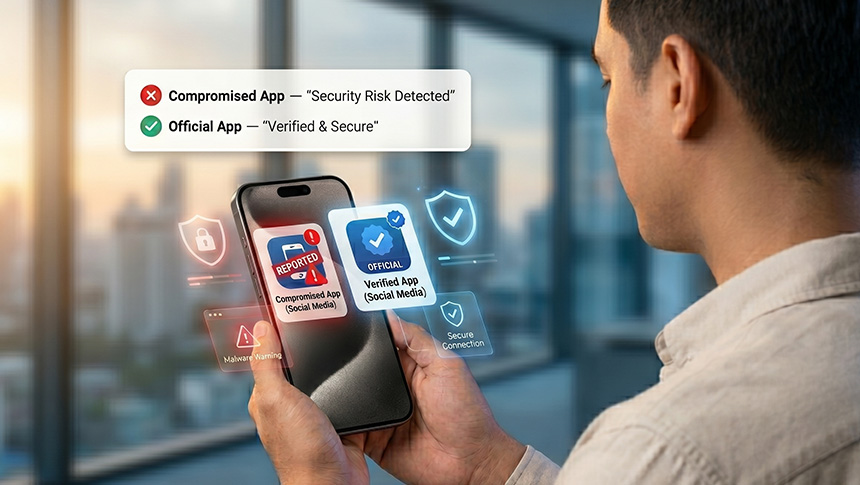
Once you understand how a mobile app works, you realize that the consequences of an app breach are fundamentally different from those of a typical infrastructure breach. When backend systems are attacked, the impact is often contained within the infrastructure itself. But when the app itself is compromised, the effects are immediate and visible to the user.
Transactions can be manipulated or intercepted. Customer data can be exposed, and sessions can be hijacked. These are not abstract technical failures—they are disruptions to the very interactions customers rely on.
And because these interactions happen in real time, the business impact is just as immediate. Revenue is affected, trust is broken, and brand perception shifts in ways that are difficult to reverse.
A 2025 study from Guardsquare highlights how mobile app security is directly tied to user trust and long-term brand perception.3 In many cases, the damage is both operational and reputational.
Rethinking What It Means to Protect the Business

As businesses increasingly rely on mobile platforms to serve customers, deliver services, and facilitate transactions, the definition of security must evolve with them.
Protecting infrastructure is no longer enough, and neither is validating apps before release. The question is no longer whether it was secure at launch, but whether it remains secure in use.
This requires a shift in approach: from protecting systems to protecting the platform where the business actually operates. It means securing apps in real-world environments, across devices and under uncontrolled conditions, and ensuring that interactions remain safe even during an active threat.
Protecting the Platform Where Business Happens
Forward-looking organizations are beginning to recognize that the mobile app is not just another layer in their digital ecosystem. It is the platform through which their business is experienced, warranting enterprise-grade cybersecurity solutions. And like any critical platform, it must be protected accordingly.
Solutions such as Globe Business’ Mobile Application Security, powered by Zimperium MAPS, are designed to extend security beyond infrastructure and into the app itself—protecting it from build to runtime, even in unpredictable environments.
Learn how Globe Business helps secure mobile applications. Because in a mobile-first world, protecting your systems is not enough. You have to protect the platform your business runs on.
Sources:
1https://www.statista.com/topics/1002/mobile-app-usage
2https://www.verizon.com/business/resources/reports/2024-dbir-data-breach-investigations-report.pdf
3https://www.guardsquare.com/blog/mobile-app-security-impacts-trust