In this article:
Digital tools have expanded learning beyond traditional classrooms, making Philippine education more flexible and responsive. Accelerated by the pandemic, technology now deeply integrates into instruction, school operations, and decision-making.
Emerging innovations like Artificial Intelligence (AI), cloud platforms, data analytics, and connected campuses offer new educational possibilities while shaping the essential skills needed for today's digital economy. Globe Business helps school leaders align IT investments with strategic goals by offering insight into these key trends.
10 Major Technology Trends Reshaping Philippine Schools
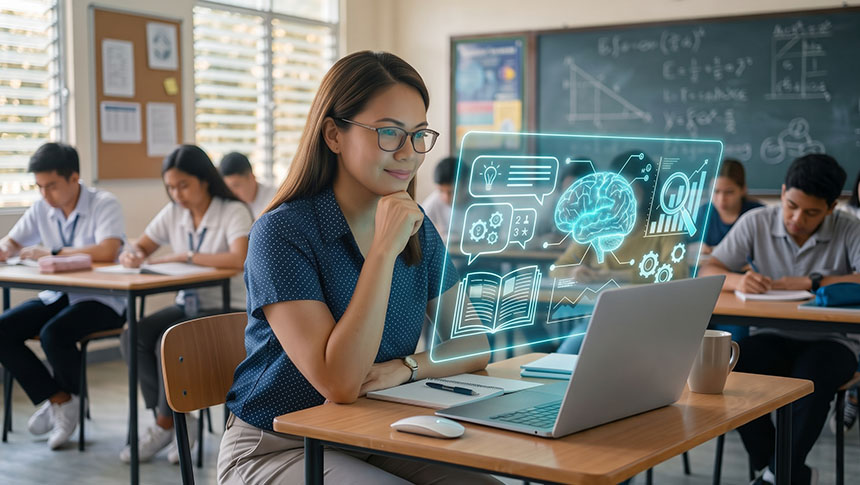
- Hybrid and Flexible Learning
This trend combines online and in-person instruction to create a unified learning experience across spaces, enabled by LMS platforms, mobile resources, and reliable connectivity.1
- AI-Powered Personalized Learning
AI assesses student progress to tailor content to individual needs. In the Philippines, the Department of Education's (DepEd) Education Center for AI Research (ECAIR) leverages AI and data to enhance learning outcomes and planning.2
- Immersive Learning
Virtual, Augmented, and Mixed Reality (VR, AR, MR) create interactive environments for complex subjects like science, healthcare, and engineering. The University of the Philippines’ (UP) Open University pioneers this via its Immersive Open Pedagogies (IOP) program, which relies on low-latency edge networks.3
- Learning Analytics
The data from digital platforms provides insights into student performance. This allows targeted academic interventions and informs institutional decisions on curriculum and resource allocation.
- Cloud-Based Learning and Collaboration
Cloud tools and school management systems offer scalable, location-independent access for students and staff.
- Blockchain Credentials
Blockchain enables secure credential verification, as seen in Philippine Science High School's (PSHS) and Department of Science and Technology’s (DOST) Pisay-DigiCert initiative for digital diplomas and transcripts.4
Institutional AI Applications
DepEd's ECAIR program5 applies AI across several operational areas.
- SIGLA: Tracks student height and weight
- TALINO: Maps schools and planning resources
- DUNONG: Processes exam data
- SALIKSeek: Chatbot for educational data
- SABAY: Assesses cognitive risk
- LIGTAS: Maps geohazards for disaster readiness
- Social Learning Platforms
Platforms such as Google Classroom and Microsoft Teams foster online peer collaboration, discussion, and teamwork.
- Foundational Digital Literacy
Preparing graduates requires core skills like evaluating online information, digital problem-solving, and effective online collaboration.
- Cybersecurity and Digital Safety
Programs like Globe’s Digital Thumbprint Program (DTP) educate students on digital safety and responsible AI use to build online safety awareness.
Strategic Considerations for Schools

Embracing these technology trends can bring new opportunities, but their impact will depend on how they are implemented. This means focusing on a few key considerations.
- Faculty Readiness: Train staff in AI literacy, data privacy, and digital practices.
- Inclusive Environments: Build flexible learning setups accounting for diverse device access and connectivity.
Goal-Aligned Investments: Focus IT investments on long-term educational goals rather than short-term hardware adoption.
Move Forward with Purpose
Technology's true value lies in how institutions leverage it to improve learning outcomes. Reliable connectivity acts as a foundational investment for long-term adaptability, and Globe Business remains committed to guiding educational institutions through this digital evolution.
Sources
1https://up.edu.ph/upholding-quality-in-higher-education
2https://www.pna.gov.ph/articles/1273098
3https://iop.upou.edu.ph/step-inside-the-future-of-education-exploring-upous-immersive-open-pedagogies-program
4https://pshs.edu.ph/pisay-launches-student-records-platform-using-crypto-technology
5https://govinsider.asia/intl-en/article/the-philippines-looking-to-reform-education-sector-with-ai-and-connectivity