In this article:
From online classes and remote work to streaming and AI-powered tools, internet access has become a necessity that supports everyday life. Yet, reliable access isn't equally available everywhere. For rural communities and islands where fiber infrastructure can be difficult to deploy, satellite internet in the Philippines offers another way to stay connected online.
This guide explains how satellite internet works, where it can be useful, and what to consider before choosing a service.
What's Satellite Internet?
Satellite internet is a wireless connectivity service that transmits internet signals between your location and an orbiting satellite. Unlike traditional fiber, cable, or other fixed-line services, there's no need to rely on physical wires.
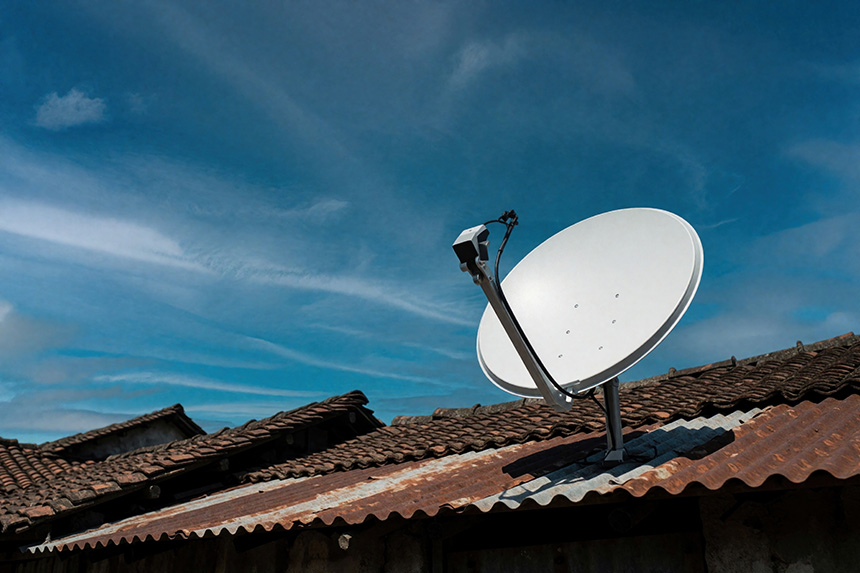
There are two main types of satellite connectivity. Dedicated satellite broadband uses a terminal or dish, while satellite-to-mobile lets compatible phones connect directly to satellites without separate hardware.
This wider reach can support internet or essential mobile access in places such as open waters, mountainous areas, and communities beyond established network infrastructure.
How Does Satellite Internet Work?
Satellite internet relays data between your device, satellites in orbit, and network infrastructure on the ground. How fast that happens partly depends on the satellite's distance from Earth.
- Geostationary Earth Orbit satellites operate about 22,000 miles above Earth, covering wide areas but generally with higher latency, or a longer delay between sending a request and receiving a response.
- Low Earth Orbit (LEO) satellites fly only a few hundred miles above Earth, helping reduce latency and improve responsiveness.
From there, the connection works in one of two ways.
With dedicated satellite broadband, your local router sends data through a satellite terminal or dish, which communicates with the satellite and a ground station connected to the internet. Satellite-to-mobile follows a similar path but skips the separate terminal, so compatible phones can connect directly to the satellite instead.
Since signals travel between Earth and space, performance can also depend on environmental factors including your surroundings and weather. This means that buildings, trees, mountains, heavy rain, and severe weather may weaken the signal or cause temporary interruptions, while Geostationary Earth Orbit services may experience more noticeable latency because of the greater distance involved.
Key Advantages of Satellite Internet in the Philippines
Despite its limitations, satellite internet has several strengths, particularly when distance, terrain, or limited infrastructure makes traditional connectivity harder to deploy.
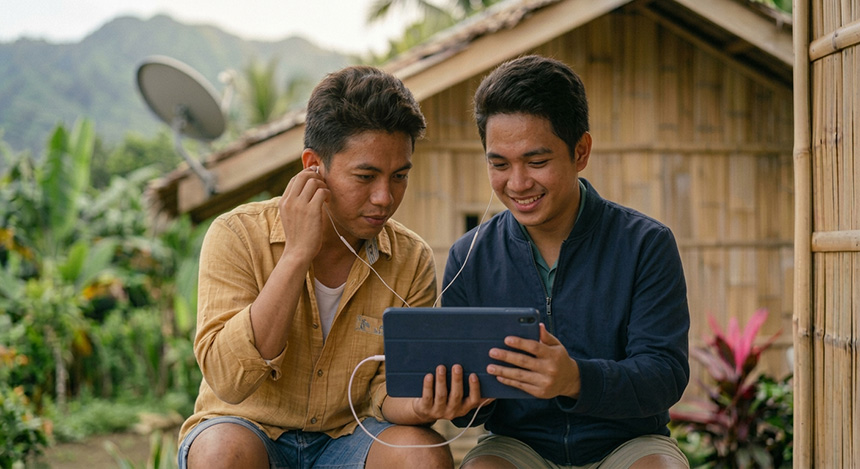
Broader Coverage for Hard-to-Reach Areas
Extending physical cables across long distances or difficult terrain can be costly and complex. Satellite services reduce that dependence on local wired infrastructure, making them useful for farms, island communities, field operations, and other locations outside established service areas.
Improved Internet Speeds
Advances in satellite technology, specifically Low Earth Orbit networks, have helped improve speeds and reduce latency compared with earlier satellite services. Depending on the provider, plan, and conditions, dedicated satellite broadband can support activities ranging from messaging and web browsing to video calls, streaming, online learning, and other data-heavy tasks.
Faster Deployment in New Locations
Satellite broadband can also reduce the need to extend new physical lines before a site gets internet access. A typical setup requires a compatible terminal or dish, networking equipment such as a router, a power source, and a suitable installation area.
For local government units, rural health centers, temporary facilities, and field operations, this flexibility can make it easier to establish online access for coordination, public services, and other operational needs.
Disaster and Outage Resiliency
Satellite links don't rely on the same local cables, telephone poles, or cell towers as terrestrial connections. When those systems are damaged by storms, earthquakes, or other disruptions, satellite services can provide a separate communications path as long as the necessary equipment, power, and satellite signal remain available.
This can support disaster response teams with coordination, timely updates, and access to essential online tools while local infrastructure is being restored.
What's the Difference Between Fiber and Satellite Internet?
Fiber and satellite internet take very different routes to get you online, so the better fit depends largely on your location and how you plan to use the connection.
| Comparison | Fiber Internet | Satellite Internet |
|---|---|---|
| Connection type | Physical wired connection through fiber-optic cables | Wireless satellite link |
| Availability | Requires fiber serviceability | Can serve areas beyond wired infrastructure, subject to satellite coverage and signal conditions |
| Performance | Stable, low-latency connection | May be affected by weather and obstructions |
| Best fit for | Homes and businesses with fiber serviceability | Areas without practical wired access |
Fiber and satellite internet address different connectivity challenges. Fiber is designed for fixed locations where wired infrastructure is available, while satellite technology can address situations where that infrastructure isn't practical.
For those with viable access to fiber service, Globe offers GFiber Postpaid for reliable home connectivity through a monthly plan. GFiber Prepaid is also available for those who want the internet with zero lock-in and more flexibility in managing their household connection.
Globe and Starlink Satellite-to-Mobile Connectivity

Globe's partnership with Starlink lets supported phones connect to LEO satellites when regular Globe coverage is unavailable outdoors. The technology has already proven vital in critical situations like when it supported emergency communications following the magnitude 7.8 earthquake that affected parts of Mindanao.
To use Globe Starlink, you'll need the following.
- A compatible LTE/4G/5G Android, iOS, or HarmonyOS device
- An active and registered Globe SIM
- An eligible Globe Starlink promo or plan inclusion
- An outdoor location with a view of the sky
- Enabled data roaming (if required by your device)
Globe Starlink is available to Globe Prepaid, Postpaid, and Platinum customers, with offers depending on the customer type. Select Starlink promos are also available to TM users. Once regular Globe mobile coverage returns, your device automatically prioritizes the terrestrial network again.





Satellite Internet FAQs
If satellite internet fits your set-up, these common questions can help you decide what to expect before getting connected.
What's the price of satellite internet in the Philippines?
Pricing depends on the type of satellite service. Starlink Residential starts at ₱4,099 per month, while Roam starts at ₱3,299 for 100 GB and ₱5,999 for Unlimited service. Hardware costs are separate.
For satellite-to-mobile, Globe's current offers include:
| Type | Offer | Inclusions |
|---|---|---|
| Globe Prepaid | Starlink 99 | 2 GB satellite data + 100 satellite texts, valid for 30 days |
| Starlink 299 | 10 GB satellite data + 500 satellite texts, valid for 90 days | |
| Globe Postpaid | Starlink 99 add-on | 2 GB satellite data + unlimited satellite texts, valid for 30 days |
| Starlink 299 add-on | 10 GB satellite data + unlimited satellite texts, valid for 90 days | |
| Eligible GPlan 1499 and up | Up to 12 months of Globe Starlink, with 10 GB satellite data and unlimited satellite texts | |
| Globe Platinum | All-New Platinum GPlans | Globe Starlink included, with unlimited satellite data and texts |
Offers and inclusions may vary by plan and can change over time, so check GlobeOne or the Globe Starlink page for the latest details before subscribing.
Where can I compare Philippine internet speeds across providers?
Several platforms can help you compare internet speeds in the Philippines, including Speedtest Awards, the National Telecommunications Commission (NTC) Quality of Service Portal, and Speedtest PH.
Can I get satellite internet at home with standard WiFi?
Yes. Residential satellite broadband typically requires an outdoor dish or terminal, WiFi router, cables, power supply, and mounting equipment.
What satellite internet options are available in the Philippines today?
Options include LEO satellite broadband such as Starlink, traditional satellite or Very Small Aperture Terminal (VSAT) services, and satellite-to-mobile solutions such as Globe Starlink.
Each serves a different purpose, so consider whether you need full broadband at a fixed location, portable internet for travel or fieldwork, or essential mobile access beyond cell towers.
Staying Connected Beyond Boundaries
Reliable internet access can make a bigger difference when you're far from the places traditional networks usually reach. Whether you're working, traveling, coordinating with others, or simply trying to stay in touch, satellite technology gives connectivity more room to go where people need it.
Through its collaboration with Starlink, Globe is helping extend satellite-to-mobile connectivity to more Filipinos, supporting access to essential apps, navigation, and communication when terrestrial networks are out of reach or temporarily unavailable.
With satellite internet, remote locations don't have to feel quite so far from the digital world.


